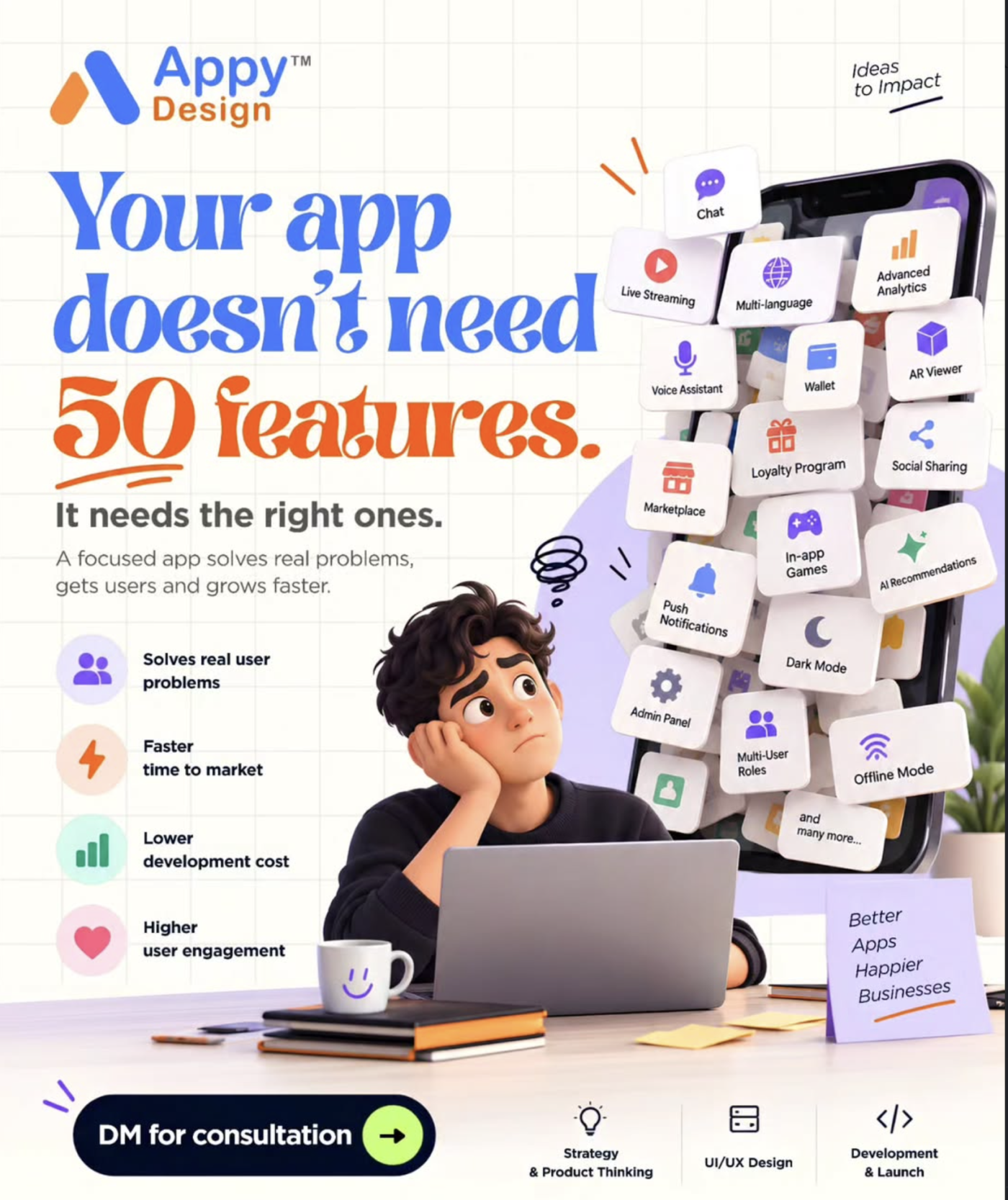
Your App Doesn’t Need 50 Features. It Needs the Right Ones.
Have you ever opened an app and wondered:
“Why does this app have so many features?”
Chat.
Live streaming.
Wallet.
Marketplace.
Loyalty programs.
Advanced analytics.
Multi-language support.
Voice assistant.
AR.
Games.
Social sharing.
AI recommendations.
Push notifications.
Dark mode.
Admin panel.
Offline mode.
The list keeps growing.
But here is the uncomfortable truth:
More features don’t automatically create a better app.
In many cases, adding too many features can make an app confusing, expensive to develop, difficult to maintain and harder for users to understand.
At Appy Design, a Chennai-based mobile app design and development studio, we believe a successful app starts with a better question:
What is the real problem we are trying to solve?
From business idea and product strategy to UX/UI design, development and launch, the focus should be on creating an app that is useful, simple and designed around real users.
Appy Design works with business owners, startups and first-time founders to turn ideas into practical mobile products. Appy Design
The Feature Trap: Why Businesses Keep Adding More
When a business decides to build a mobile application, the first conversation often sounds like this:
“We need login.”
Then:
“Let’s add chat.”
Then:
“Can we add a loyalty program?”
Then:
“What about AI recommendations?”
Then:
“Maybe we should add a marketplace.”
Before long, the original idea has turned into a huge product with dozens of features.
The problem isn’t that these features are bad.
The problem is adding features without understanding whether users actually need them.
A good mobile application should answer three fundamental questions:
1. Who is going to use it?
2. What problem are they trying to solve?
3. What is the easiest way to solve that problem?
These questions should come before deciding what features to build.
What Makes a Good Mobile App?
A successful mobile app is not simply a collection of screens.
It is an experience.
Consider a food delivery app.
The user’s primary objective might be:
Find food → Choose food → Pay → Track delivery
If the app makes this journey simple, the product is doing its job.
Now imagine placing 30 additional features between these steps.
The app may technically offer more functionality, but the core experience becomes harder.
That’s why UX design is an important part of mobile app development.
At Appy Design, the process begins by understanding the business, customers, challenges and goals before defining the product roadmap. Appy Design
Start With the User Problem, Not the Feature List
Imagine a business owner says:
“I want to build an app for my customers.”
Instead of immediately starting development, a product team should ask:
Why?
Perhaps customers currently have to call the business to make appointments.
The actual problem isn’t:
“We need an appointment app.”
The actual problem is:
“Customers need a faster way to book appointments.”
That difference is important.
Once the problem is understood, the solution may require only:
- Customer registration
- Service selection
- Available time slots
- Booking
- Payment
- Notifications
- Booking history
That’s potentially enough for the first version.
No unnecessary marketplace.
No social network.
No games.
No complicated AI dashboard.
Just the functionality required to solve the problem.
What Is an MVP?
This is where MVP development becomes important.
MVP stands for Minimum Viable Product.
An MVP is not an unfinished application.
It is a focused first version containing the essential functionality required to test a product idea with real users.
For example:
Instead of building:
50-feature food delivery platform
Start with:
Restaurant discovery → Food selection → Checkout → Order tracking
Then observe how users interact with it.
Based on feedback, the product can evolve.
Appy Design specifically describes startup MVP development as creating a focused first version that allows businesses to test, learn, attract users and grow. Appy Design
Why a Focused App Can Be Better for Business
Reducing unnecessary features can have several practical benefits.
1. Faster Time to Market
The fewer unnecessary features you build initially, the less development work is required.
A focused product can move from idea to prototype and development more efficiently.
For startups, this can be particularly important because the objective is often to test an idea in the real market rather than spend months building something users may not want.
2. Lower Development Cost
Every feature has a cost.
It requires:
- UX design
- UI design
- Development
- Testing
- Backend infrastructure
- Maintenance
- Security considerations
- Future updates
Removing unnecessary features from the first version can reduce the initial development scope.
That doesn’t mean the features can never be added.
It means:
Build what matters first.
3. Better User Experience
Users don’t want to learn how your application works.
They want to accomplish something.
A good mobile app should make the next action obvious.
For example:
Book an appointment
should feel like:
Choose service → Choose time → Confirm
rather than:
Dashboard → Explore → Discover → Categories → Services → Offers → Recommendations → Booking
Good UX reduces unnecessary decisions.
4. Easier Product Development
A focused product is easier for a development team to understand, test and maintain.
Instead of managing dozens of interconnected features, the team can concentrate on the critical user journeys.
This becomes especially important when building:
- Startup MVPs
- Business management apps
- Customer apps
- Booking applications
- Service marketplaces
- Membership apps
- E-commerce apps
- Internal business applications
5. Easier to Improve
Your first version doesn’t need to be your final version.
In fact, successful products often evolve based on:
- User feedback
- Analytics
- Customer behaviour
- Business requirements
- Market changes
A better approach is:
Launch → Learn → Improve → Scale
rather than:
Plan 50 features → Build everything → Launch → Hope users like it
App Development Should Start With Product Strategy
Before writing code, there should be a clear understanding of the product.
At Appy Design, the process is structured around:
Discover
Understand the business, customers, challenges and objectives.
Define
Convert the idea into a practical product roadmap.
Design
Create user flows and intuitive UX/UI experiences.
Develop
Build the product with performance, quality and scalability in mind.
Launch
Prepare the application for release.
Grow
Use real user feedback and business goals to continuously improve the product. Appy Design
This approach connects strategy, UX/UI design and development rather than treating development as a completely separate activity.
Mobile App Development in Chennai Is Changing
Chennai has a strong ecosystem of technology companies, startups, enterprises and digital businesses.
Businesses across industries are increasingly looking at mobile applications to improve customer experiences and streamline operations.
A mobile application can help a business with:
- Customer bookings
- Online orders
- Customer loyalty
- Memberships
- Payments
- Service requests
- Internal operations
- Customer communication
- Notifications
- Business analytics
- Digital services
The requirement isn’t necessarily to build the biggest application.
The goal is to build the right application for the business.
Why Choose Appy Design for Mobile App Development in Chennai?
If you’re searching for a mobile app development company in Chennai, you will find many technology companies offering development services.
But app development isn’t only about writing code.
The product also needs:
Strategy + UX + UI + Development + Testing + Launch
Appy Design positions itself around this complete product journey.
The studio works with business owners, startups and first-time founders and offers custom Android and iOS applications designed around business requirements. Appy Design
Its stated services include:
- Custom Android & iOS apps
- Business management applications
- Customer experience applications
- Startup MVP development
- Local business applications
- App modernization
- Mobile app UX/UI design
- Product strategy
- Development
- Launch support Appy Design
Android and iOS App Development in Chennai
Businesses often need applications for both major mobile platforms.
Depending on the product strategy, an app may need to support:
Android
Useful for reaching a broad mobile audience across India and other markets.
iOS
Important when the target audience includes Apple users and premium customer segments.
Cross-platform development
Can also be considered when the product strategy requires a shared codebase and efficient development across platforms.
The technology choice should come after understanding the product requirements, rather than selecting technology first.
UI/UX Design Is Not Decoration
One common misconception is that UI/UX means making an application look attractive.
Visual design is important.
But UX goes much deeper.
UX design considers:
- User goals
- Information architecture
- User flows
- Navigation
- Interaction design
- Accessibility
- Usability
- Error prevention
- Content
- Feedback
- Conversion
For example, a beautiful checkout screen doesn’t help if users don’t understand how to complete their purchase.
That’s why mobile app design in Chennai should be approached as a product-design challenge rather than simply a visual-design exercise.
From Idea to App: A Simple Example
Imagine a Chennai-based business that provides home services.
The initial idea might be:
“We need an app like a marketplace.”
Instead of immediately building a huge platform, start by identifying the core user problem.
User Problem
Customers struggle to find reliable service providers quickly.
Core Solution
A mobile app that allows users to:
- Select a service
- Choose a location
- View available professionals
- Select a provider
- Request a service
- Track the request
Future Features
Once the core experience works, the business can consider:
- Ratings
- Loyalty
- Wallet
- Subscription
- Referral programs
- AI recommendations
- Multi-language support
- Advanced analytics
The difference is that features are added based on product needs rather than assumptions.
The Right Features Can Create the Right Business Impact
A well-designed mobile application can help businesses create measurable value.
Better Customer Engagement
Give customers a convenient digital channel to interact with your business.
Faster Operations
Replace repetitive manual processes with digital workflows.
Better Customer Experience
Make booking, purchasing, requesting or communicating easier.
New Revenue Opportunities
Mobile applications can introduce memberships, subscriptions, digital services and repeat purchases.
Better Customer Retention
A useful product gives customers a reason to return.
Appy Design describes these types of outcomes in terms of customer engagement, lighter day-to-day operations and new revenue opportunities. Appy Design
What Should You Build First?
Before starting your next app development project, create a simple feature-priority framework.
Must Have
Features required for the core product to work.
Should Have
Features that significantly improve the experience but aren’t essential for launch.
Could Have
Features that can be introduced after validation.
Not Yet
Interesting ideas that don’t solve the immediate user problem.
This simple framework can prevent feature creep and keep your product development focused.
Building an App? Start With a Conversation
You don’t need to have everything figured out before approaching an app development company in Chennai.
You may only have:
- An idea
- A business problem
- A rough sketch
- A customer requirement
- An existing application that needs improvement
- An idea for a startup
- A manual process you want to digitize
That’s enough to start the conversation.
Appy Design’s approach is to help shape the idea, define the product, design the experience, develop the application and support the launch. Appy Design
Build Less. Solve More.
The future of mobile applications isn’t necessarily about adding more and more features.
It’s about creating better experiences around real problems.
Your app doesn’t need:
50 features.
It needs the right features.
It needs to understand its users.
It needs a clear purpose.
It needs thoughtful UX/UI design.
It needs reliable development.
And most importantly, it needs to create value for the people using it.
Have an app idea?
Appy Design — Chennai
Strategy • Product Thinking • UI/UX Design • Development & Launch
Bring your idea.
Bring your business challenge.
Bring your vision.
Let’s turn your idea into an app people actually use.
Leave a Reply